Many software developers utilizing AI are working with one of two harnesses: Claude Code or Codex. For complex work like software engineering, having access to frontier models is useful, and they often provide very large context windows (like Claude’s 1M token window size).
That being said, we’d all like to save on token costs and usage for these tools. The solution typically presented to solve this is to use local models instead. It’s easy to burn tokens on grunt work that could be done by your GPU instead of letting it sit idle.
Most tooling though pushes users towards a binary choice: go with the hyperscalers, or build a homelab and run your own local models.
We believe that the best UX (at the moment, at least) lies somewhere in-between. The problem is making a hybrid approach easy to use while keeping the tools people are familiar with.
We’d like to present a reasonable middle ground for using Claude/Codex and local models.
Introducing yeschef: let your agents cook 🧑🍳
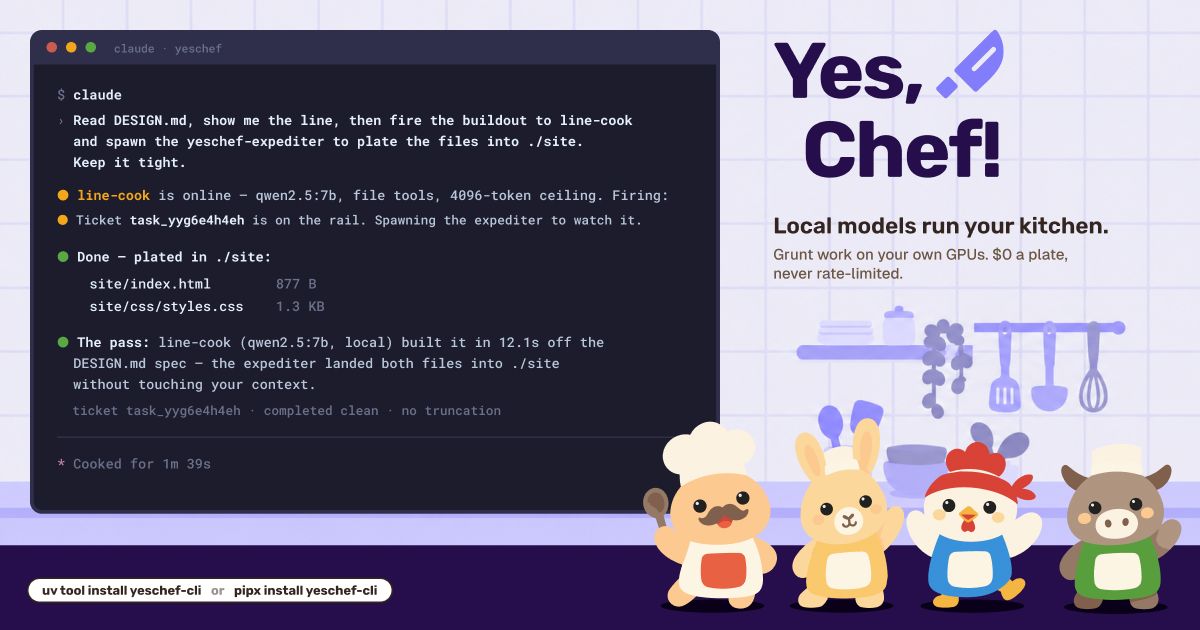
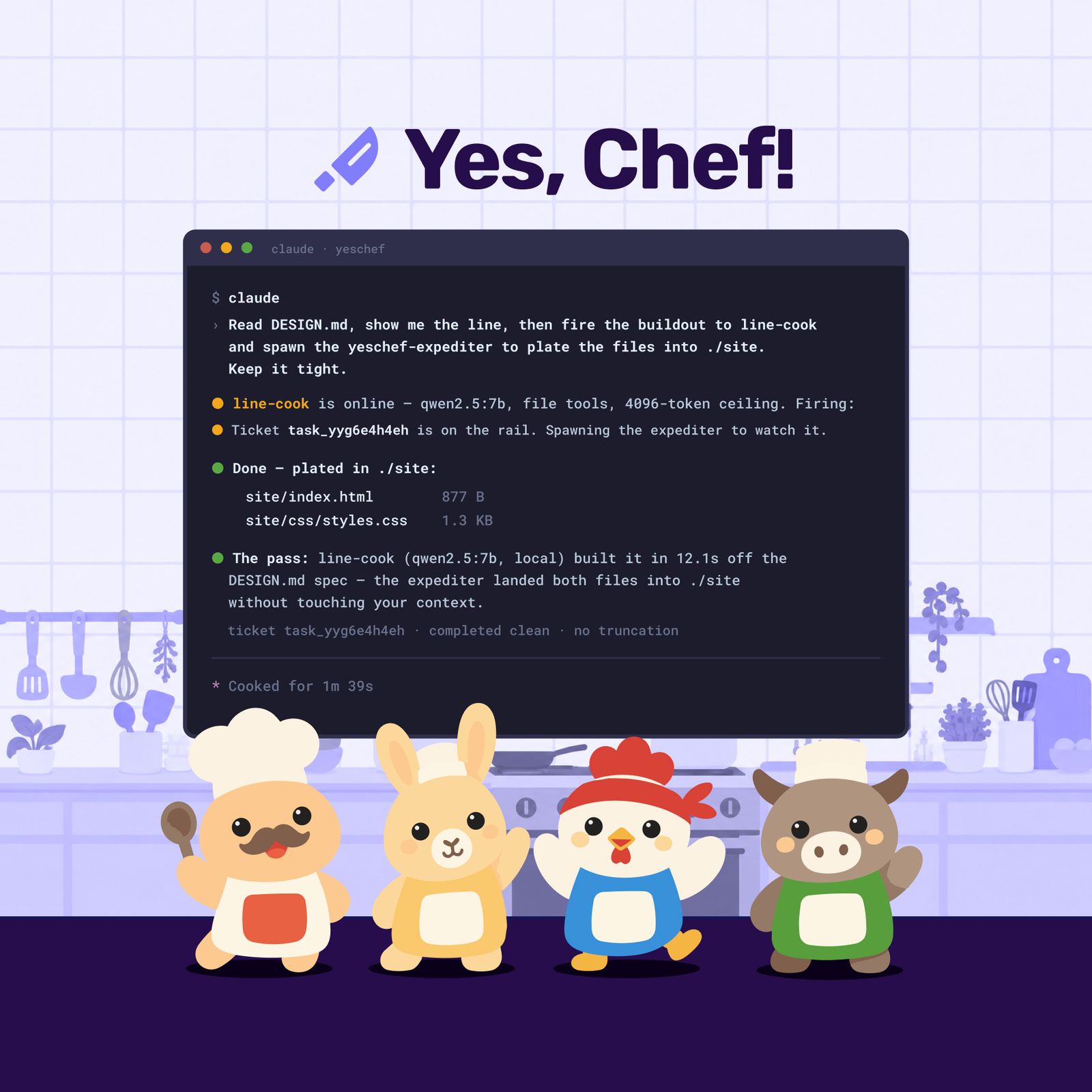
yeschef gives Claude Code (or Codex) to local subagents that they can delegate work to, in order to save on token costs/subscription usage.
For example, you could use Fable 5 to create a landing page, and ask it to pass off a smaller task like drafting the copy for an FAQ page to a local “cook”.
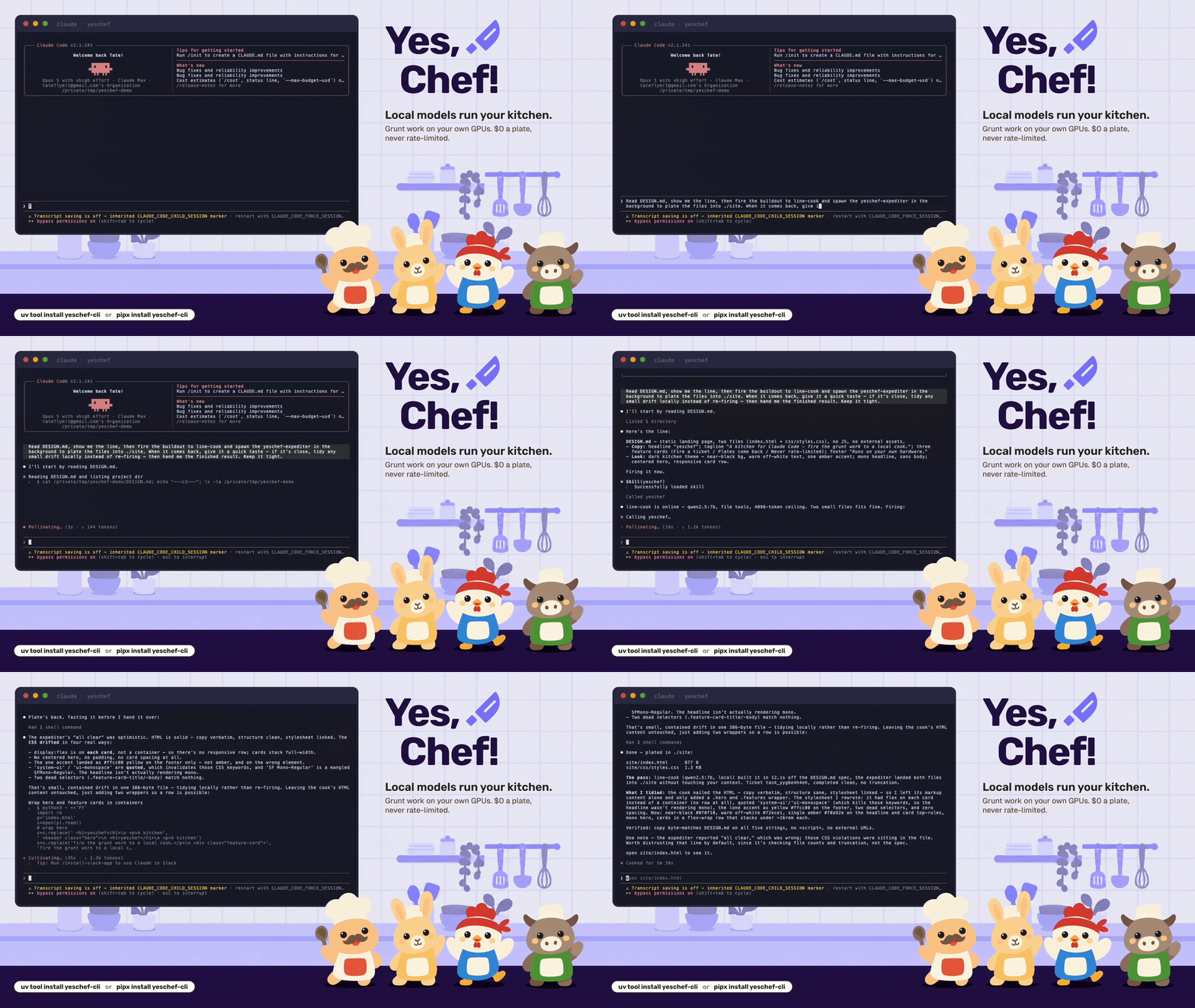
This means the more powerful (and expensive) model does the important work, and a local model can handle easier, self-contained tasks which otherwise might be a waste of usage.
yeschef can be used in two different ways: for background tasks, like the one in the example (submit a job to a cook and retrieve the output), or for rooms, which sets up a dialogue between multiple models to work on a problem.
yeschef is useful for:
- Grunt work (like summarize, classify, extract and triage tasks)
- Long-running work
- When you’re rate-limited/throttled
- You need a second opinion (and don’t want to make another API call)
and works for a single machine or across machines on your network.
Why not use built-in subagents?
Subagents spun up by Claude Code and Codex use the same hosted models as your main agent, not local models or any other provider you set up. This means they contribute to the same token usage or quota your subscription has, which yeschef sidesteps entirely.
Built-in subagents also only exist within your current agent session. Subagents initialized with yeschef are durable and persist through different terminal sessions, and can even use another machine on your network.
This is a different problem than just parallel task delegation and execution.
Getting Started
You can install yeschef using Python.
We recommend using uv as the package manager:
uv tool install yeschef-cli    # or: pipx install yeschef-cli

# 1. On the hub machine (where you run Claude Code) — generates tokens,
#    wires Claude Code, prints the clock-in line:
yeschef up

# 2. On each machine that will cook — auto-detects Ollama / vLLM / LM Studio,
#    verifies the model answers, clocks the cook in.
yeschef join --hub <http://hub-host:8787> --token <printed-by-up>
Or, point your agent at the GitHub repository and ask it to install it.
yeschef will automatically detect Cascadia, Exo, Ollama, vLLM, and LM Studio and use the models they serve to process tasks.
It’s also compatible with the majority of standard providers, so you could wire it up to something like OpenRouter to hand tasks to discounted models.
Get started here and let your local agents cook for Claude and Codex.
Related articles
Research
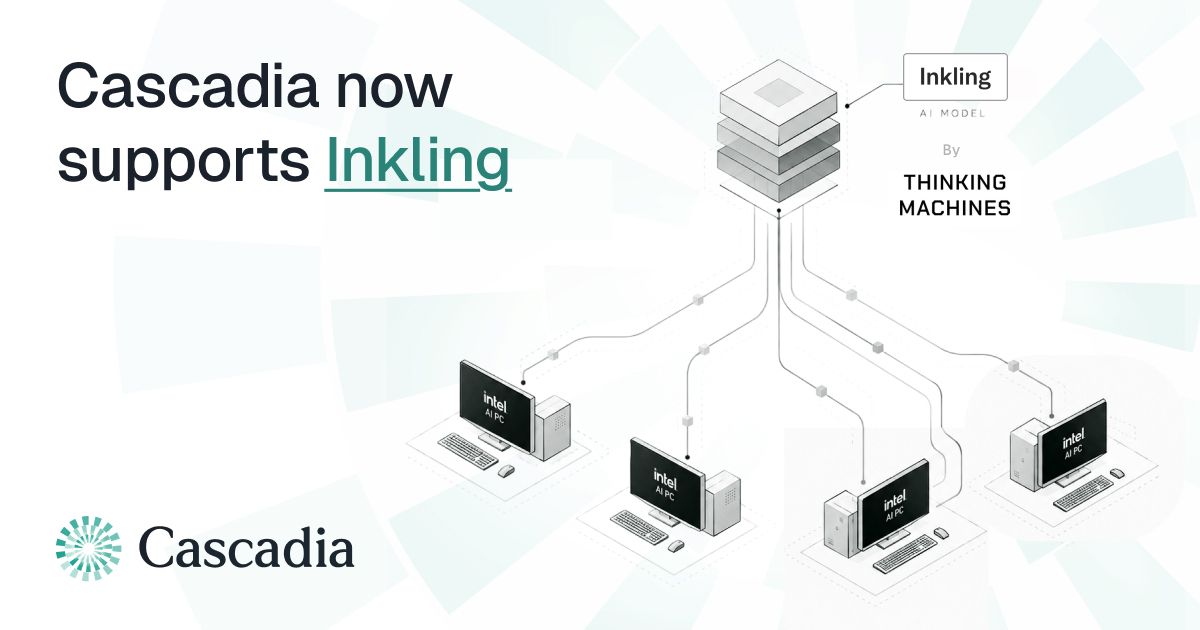
Running Inkling (975B) Across Eleven Intel PCs with Cascadia
We ran Thinking Machines' Inkling (975B) across eleven Intel Core Ultra PCs using Cascadia, reaching a peak of 60.29 tok/s of aggregate decode throughput with 88 concurrent requests.
Read more
Research
Where NPUs Fit into LLM Inference
Most modern laptops now ship with an NPU, but few people use it for running LLMs.
Read more
Research
Building a Permissioned, Peer-to-Peer AI Inference Network
How a permissioned peer-to-peer system can turn a fleet of PCs into a single, on-prem inference endpoint.
Read more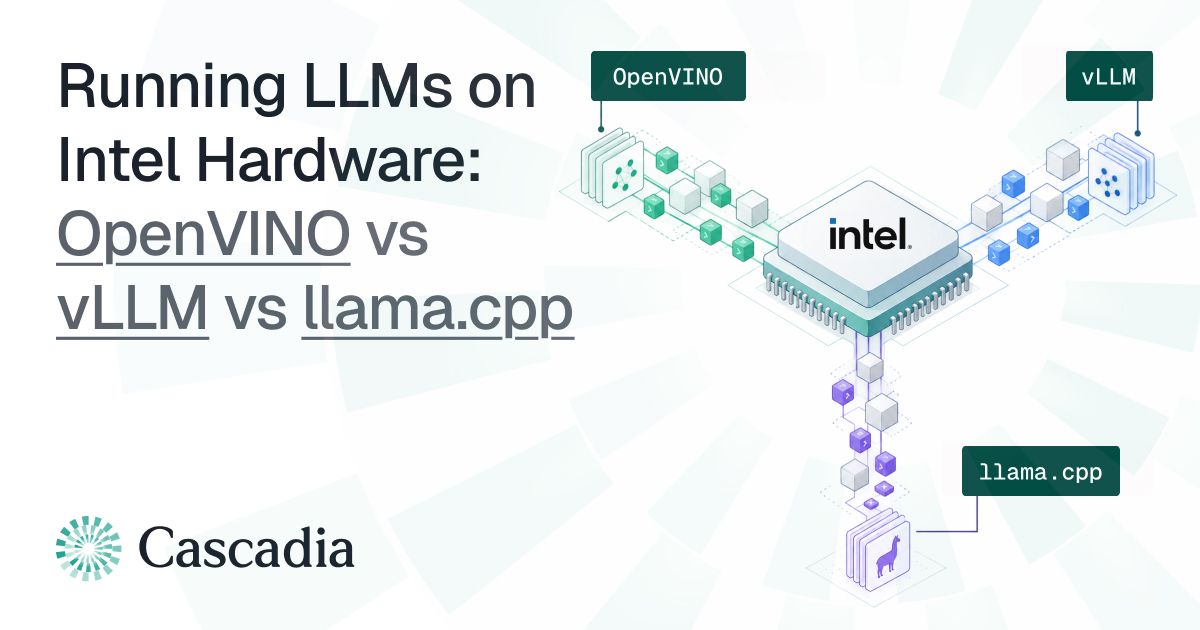
Research
Running LLMs on Intel Hardware: OpenVINO vs vLLM vs llama.cpp
Comparing various runtimes for Intel hardware.
Read more
Research
Where We're Going, We Don't Need Data Centers.
Data centers are being rapidly constructed for the purpose of training and serving AI models, but the demand for new data centers is largely predicated on the growth of AI inference.
Read more
Announcement
Cost-Efficient AI on the Hardware You Already Own
Cut your AI spend by putting the CPUs and NPUs you own to work.
Read more
