Most people today interact with AI through agents like Claude and Codex, however this approach comes with inherent issues such as hitting usage limits, costs, and privacy concerns (you might not want to send every request to the cloud). Not to mention that while you’re paying for cloud inference, your own GPU is likely sitting idle (more details in the yeschef announcement post here).
We created yeschef to help alleviate these issues. It’s a CLI tool that allows Claude Code to delegate smaller tasks to local models, and as of today, it now supports Apple’s Foundation Models as a backend. This means Claude can hand off easier tasks to the local Apple models on your machine and you can save on your Claude usage.
What changed
Apple has been shipping on-device models since as early as 2024, but in their June 2026 WWDC event, they demoed their Foundation Models in detail, and introduced the ability to access the models via CLI (available with the fm command).
Since this fall and the broader release of macOS 27, these capable local models along with the fm CLI come pre-installed on Apple devices. This means you no longer need mess around with Swift or Xcode to access Apple’s LLMs: you can access them via an OpenAI-compatible API, just like any other local model server.
Using yeschef with Apple’s Foundation Models
yeschef supports fm serve as a backend, meaning you can allow Claude to call on Apple’s local models to complete smaller or simpler tasks. The backend is designed to only rely on the system model and avoid Apple’s Private Cloud Compute (pcc) option in the CLI, so that delegated tasks only happen on-device.
To get started, follow the instructions in the yeschef GitHub repository here (or alternatively point your agent at the repository and ask it to use the fm serve backend).
Related articles

Research
Running Local AI on Business Laptops: What Hardware Do You Actually Need?
Many business laptops and workstations can now run capable AI models locally. This post covers what running AI on-device actually involves and how much RAM you need for different kinds of work.
Read more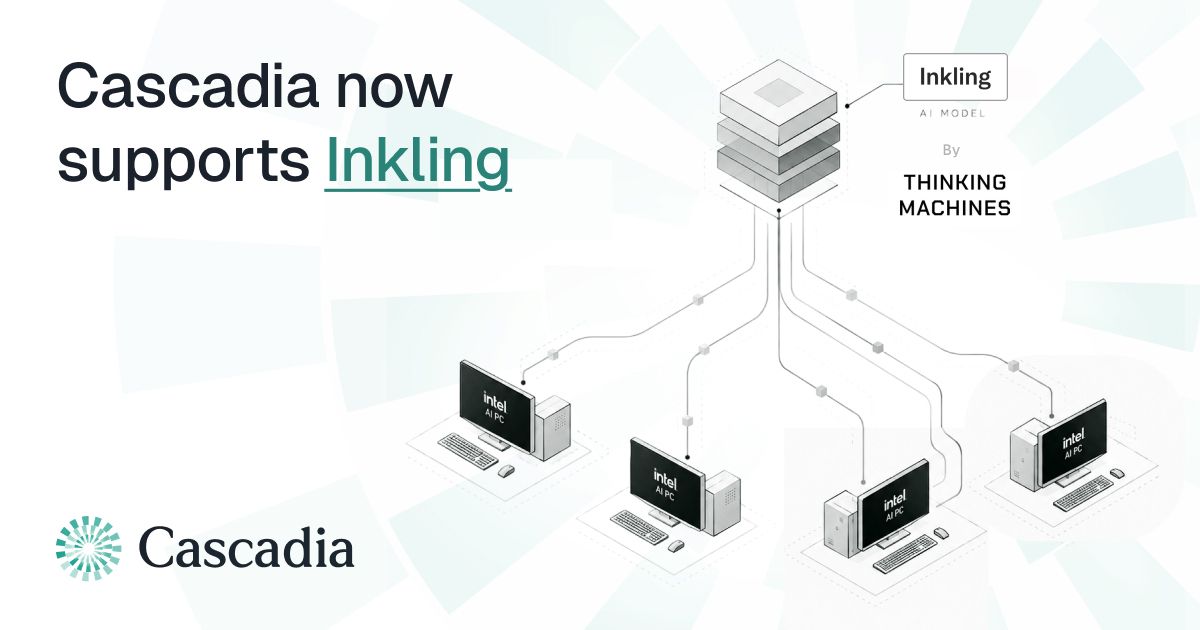
Research
Running Inkling (975B) Across Eleven Intel PCs with Cascadia
We ran Thinking Machines' Inkling (975B) across eleven Intel Core Ultra PCs using Cascadia, reaching a peak of 60.29 tok/s of aggregate decode throughput with 88 concurrent requests.
Read more
Research
Where NPUs Fit into LLM Inference
Most modern laptops now ship with an NPU, but few people use it for running LLMs.
Read more
Research
Building a Permissioned, Peer-to-Peer AI Inference Network
How a permissioned peer-to-peer system can turn a fleet of PCs into a single, on-prem inference endpoint.
Read more
Research
Running LLMs on Intel Hardware: OpenVINO vs vLLM vs llama.cpp
Comparing various runtimes for Intel hardware.
Read more
Research
Where We're Going, We Don't Need Data Centers.
Data centers are being rapidly constructed for the purpose of training and serving AI models, but the demand for new data centers is largely predicated on the growth of AI inference.
Read more
