
How it works
Turn your machines into one AI system.
Install Cascadia on the Intel AI PCs you already own. They find each other, share the work, and serve AI together, all inside your network.
The big idea

A network, but your data never leaves it.
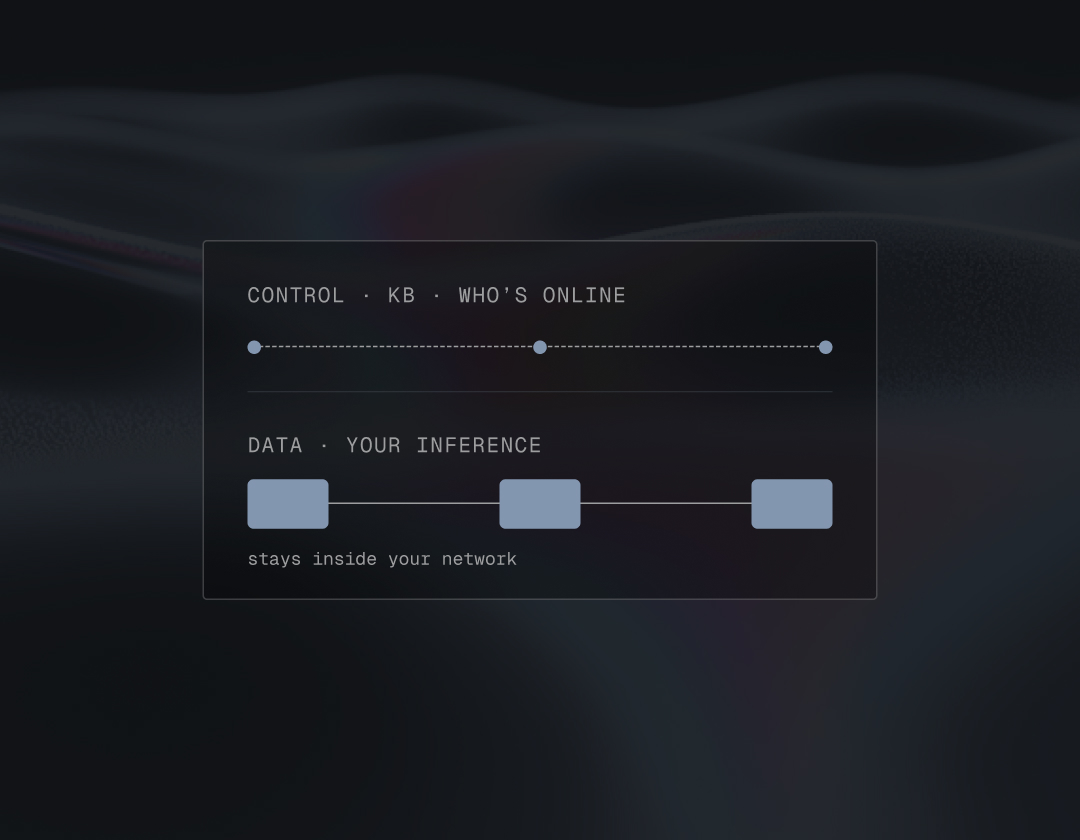
It's fair to ask: if it's a network, does my data leave? No. There are two planes, and only the small one is shared.
control plane · tiny
Coordination
Who's online, who's least busy. Kilobytes. No prompts, no documents.
data plane · private
Your inference
Prompts, context, tokens. A direct path between your own machines that never touches the internet.
in three steps
Install, discover, route.

01
Install the same binary on each Intel AI PC.
02
Discover as machines advertise spare capacity to each other.
03
Route each request to the best node; it returns a signed receipt.
one mesh, three modes
The same network, however big the model.

A single AI PC
Serve a model on one machine. Mesh dormant.
01.
A load-balanced pool
Full model on every node; the work fans out.
02.
Split across machines
A model too big for one PC, chained across several.
03.
A request across the fleet

Enters any node. Served by the best one. Streamed back, signed.

enters any node

authenticate

scheduler picks best peer

served on CPU, GPU, or NPU

tokens stream back · signed
every hop across your fleet, inside your network
Infrastructure • Cascadia Enterprise
What each part does, and why it matters.


Identity
ed25519 keypair is the machine's peer ID. Every peer is cryptographically named.

Transport
QUIC + Noise, with NAT traversal. Encrypted peer-to-peer, even across subnets.

Gossip & scheduler
Nodes advertise models and load; routing picks the best. The mesh self-organizes.

Inference
OpenVINO on CPU + NPU + iGPU. Uses the NPU others leave idle.

Admission
A CA issues node certs and partner tokens. Off the request path, fail-static.

Provenance
Signed receipt and hash-chained log per request. Prove where every token ran.
The export pipeline
From a Hugging Face handle to a serving fleet.
Any Hugging Face transformer exports to self-contained OpenVINO INT4 shards, then runs in one of the three modes: a single PC, a load-balanced pool, or split across machines.

HF handle

trace + convert

INT4 (group 128)

shard per stage

deploy

Capable today. More with every release.
Live
Serve models across a mesh of Intel NPUs, and split a model too big for any single machine across your whole fleet, with the mesh routing around a node that drops. With admission control, a signed receipt for every request, and encrypted links that reach every machine on your network.
Requirements
Runs on the hardware you already have.

Silicon

OS
Windows 11 • 23H2+
Runtime
OpenVINO 2026.1
Toolchain
Rust 1.95+ • edition 2024
Network
TCP/IP • LAN • no special fabric