
Today, many organizations play cloud AI providers for access by the token. This is convenient, but is not a metric that aligns with most businesses. The cost only increases as each team adopts AI and increases their usage.
It also doesn’t account for the fact that companies already have hardware available sitting on their desks. Countless desktop computers and laptops ship with iGPUs and NPUs purpose-built to run AI, yet in most cases this available computing power sits idle.
The growing cost of rented compute and the underutilization of existing hardware is one of the biggest inefficiencies in corporate technology spending today.
The problem with per-token pricing
The pricing model for cloud AI inference works against the buyer in two ways.
Firstly, token-metered services are an unpredictable cost. Businesses are familiar with per-user and per-seat software licenses, and can comfortably account for this in their yearly budgets. While cloud AI providers do offer per-seat plans, these don’t work for companies doing a lot of automation (which use a lot of compute but don’t necessarily take up a “seat”), and often have fluctuating limits on usage.
Although the cost of a single token is decreasing over time, AI agents are running increasingly complex workflows resulting in higher net token usage. As mentioned, this also means the more a company adopts AI, the more they have to pay. This makes it an extremely difficult expense to account for.
The second way it works against buyers is that it physically cannot be adopted by certain industries. Many organizations in media, professional services, healthcare, and other public sectors likely need AI the most, and outside of the cost, they can’t allow their data to leave the building. The industries that could benefit from AI the most, therefore, have to adopt it more slowly because of legal limitations rather than technological ones.
The solution: Cascadia
To solve this problem we built Cascadia: software that turns the fleet an organization already owns into private AI infrastructure.
Cascadia splits AI models across the computers on your network, so machines that could usually run one small model can instead run larger, more powerful models by working together.
For employees and users, nothing about their experience using AI changes. What changes with Cascadia is where their work is happening.
They can continue performing the same tasks and workflows as they were previously, but the AI requests and workloads happen within your own network, on devices you own, rather than on someone else's infrastructure.
Use cases by industry
Cascadia works for organizations with fleets of any size, but the largest benefits are for industries dealing with sensitive and/or proprietary data.
A few examples of what a private, in-house AI can do for different industries:
Media
Newsrooms and studios work with unreleased material every day such as scripts, footage logs, and embargoed stories. A private assistant can summarize, search and draft against that material without needing to share assets with a third-party (or a token bill associated with it).
Professional services
Law and advisory firms have confidentiality obligations that make cloud AI a hard conversation with every client. Running on the firm's own machines, an assistant can review documents, compare drafts and prepare summaries while privilege and confidentiality stay intact.
Healthcare and the Public Sector
Patient records are some of the most protected documents to exist, and as such, are usually off limits to share with cloud providers, even with Zero Data Retention (ZDR) agreements. Running in-house AI can help staff summarize notes, and perform internal search tasks while staying compliant with regulations in their respective regions.
The same applies to government bodies, which are required by law to store and process citizen data on infrastructure they own. Cloud-based providers may also back up or replicate data across different countries. Using AI on a government-owned fleet helps protect the sovereignty of their citizens’ data.
Manufacturing and telecom
Operations teams sit on decades of manuals, procedures and internal documentation. A private assistant that has read all of it can turn this into useful information people can use without sending anything out of their network.
The economics of on-prem AI
Running AI on your own fleet with Cascadia can cost you 47–56% less per user per year, and if each employee works from a single machine, the advantage can reach 73–78%. This is compared to the prices of standard per-user AI tools that are already in most company budgets.
Cascadia also works on a fixed-cost, per-device basis, which can help reduce the variability of costs. There is no per-token cost, and so teams can encourage the use of AI internally without being constrained by token budgets.
Join Our Pilot Program
We’re currently offering a free pilot program to select partners who wish to try out Cascadia. We’ll set up your first private AI agent in under a week on your own hardware, and we measure success based on your own internal workloads and cost savings rather than arbitrary benchmarks.
After the pilot program ends, if you’re convinced we’ll transfer you to a predictable per-device enterprise plan. If not, you’ll at least know what your hardware is capable of.
If you’d like to try out Cascadia and save on your token costs, book a discovery call with us here.
Related articles
Announcement
Use Apple Foundation Models as Claude Code Subagents
yeschef now supports Apple Foundation Models on macOS 27, so Claude Code can delegate smaller tasks to Apple’s on-device model and save on your Claude usage.
Read more
Research
Running Local AI on Business Laptops: What Hardware Do You Actually Need?
Many business laptops and workstations can now run capable AI models locally. This post covers what running AI on-device actually involves and how much RAM you need for different kinds of work.
Read more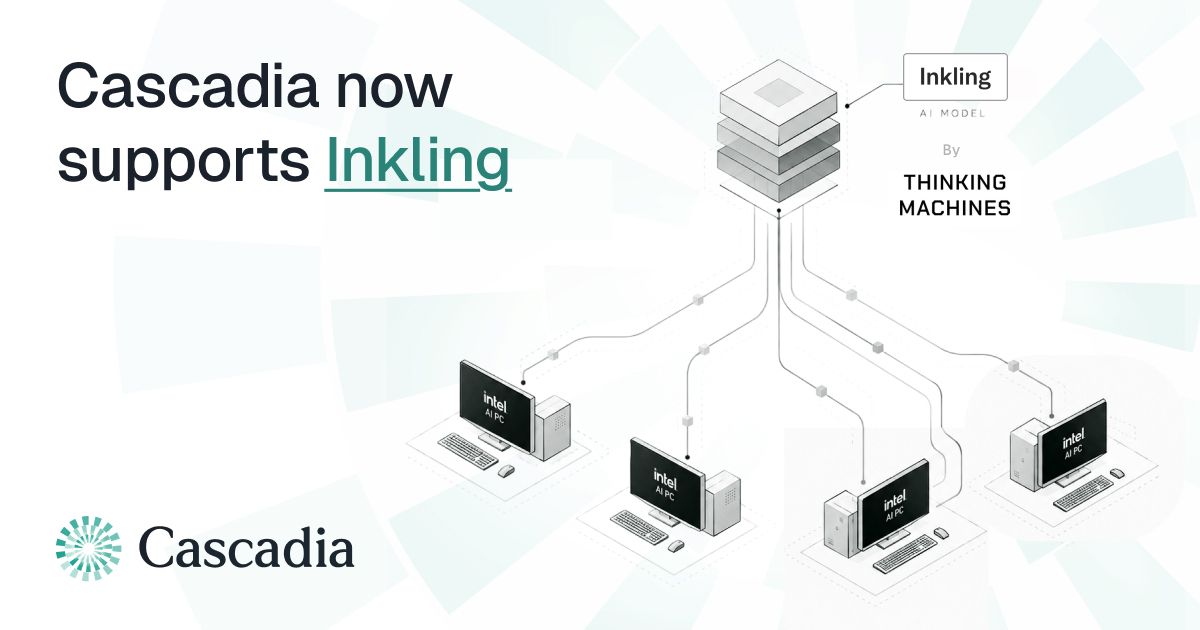
Research
Running Inkling (975B) Across Eleven Intel PCs with Cascadia
We ran Thinking Machines' Inkling (975B) across eleven Intel Core Ultra PCs using Cascadia, reaching a peak of 60.29 tok/s of aggregate decode throughput with 88 concurrent requests.
Read more
Research
Where NPUs Fit into LLM Inference
Most modern laptops now ship with an NPU, but few people use it for running LLMs.
Read more
Research
Building a Permissioned, Peer-to-Peer AI Inference Network
How a permissioned peer-to-peer system can turn a fleet of PCs into a single, on-prem inference endpoint.
Read more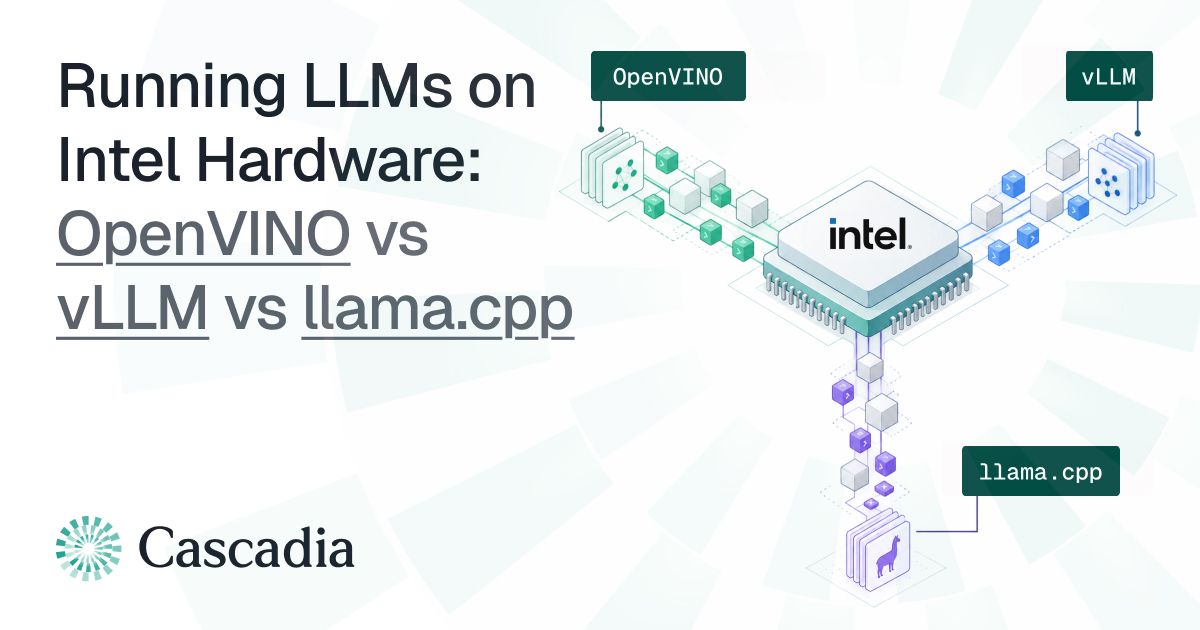
Research
Running LLMs on Intel Hardware: OpenVINO vs vLLM vs llama.cpp
Comparing various runtimes for Intel hardware.
Read more
