Today, we’re excited to announce Cascadia, a new open source runtime which pools the resources of Intel-powered machines, allowing them to run models larger than any single machine could.
Many organizations own hundreds or even thousands of commodity PCs. Yet, most of that compute sits idle while AI workflows are sent to the cloud.
Developed in collaboration with Intel, Cascadia turns these machines into a private AI network that you own. Run inference across everything from a single Intel-powered laptop to a fleet of AI PCs, or a dedicated box of Intel Arc Pro GPUs. All machines running one model, or many running several.
How Cascadia Works
LLMs come in varying sizes and capabilities. The bigger they are, the more RAM (or VRAM) they require to run. This usually means you’re limited to whatever can fit comfortably on your device. If you need a bigger model, you need more memory. Cascadia removes that single-device memory ceiling.
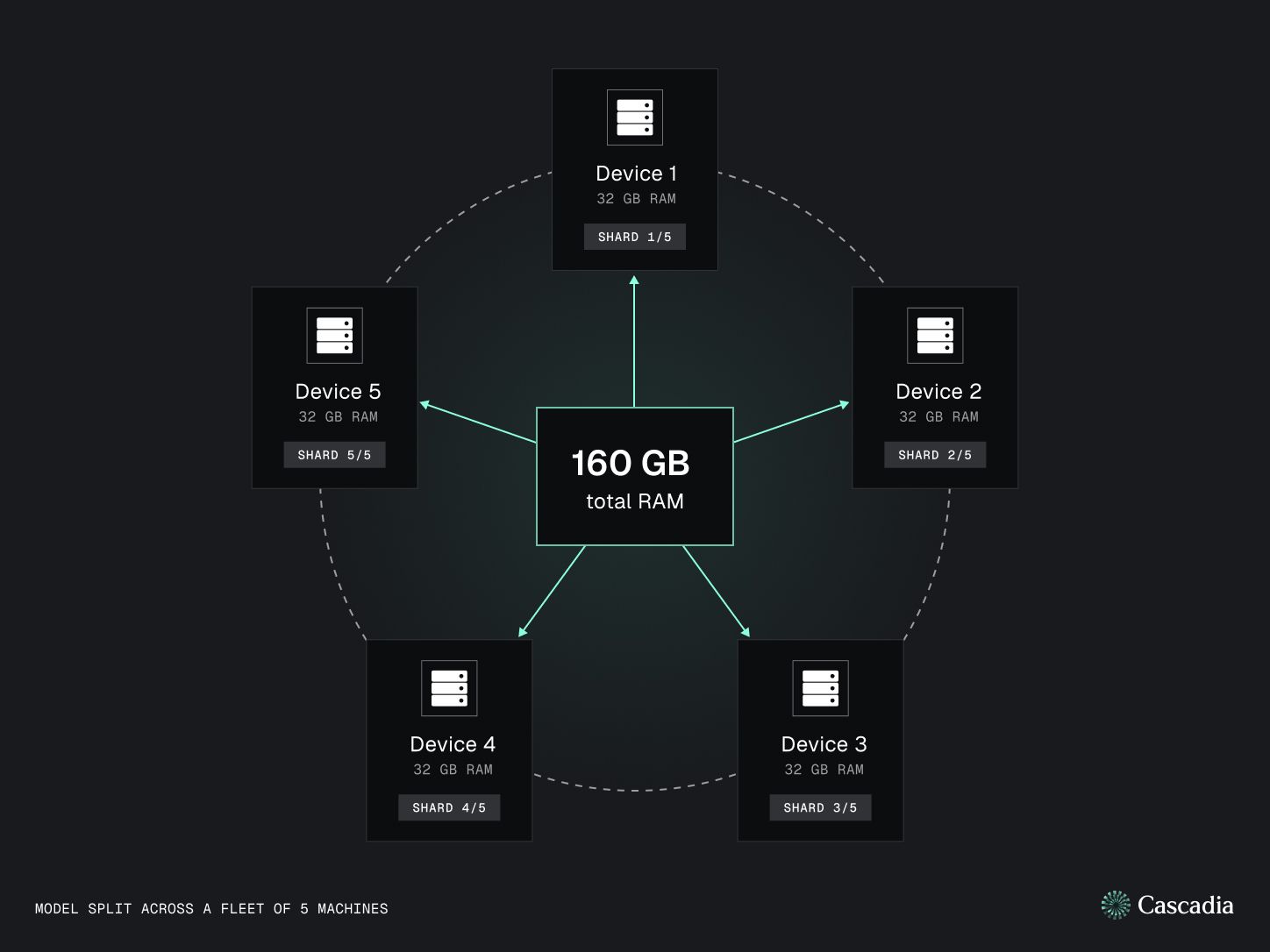
AI models are made up of layers, and Cascadia splits groups of these layers into shards. The shards are distributed across any number of Intel machines, and pool the resources of your existing PCs together to run larger models than any single machine could.
For example, you could split Llama 3.1 70B (~36GB in size, INT4 quantized) across a fleet of standard PCs.
Sharded inference isn’t new (shoutout to Exo), but the techniques used are built on novel research specifically optimized for Intel silicon.
Cascadia’s sharding is built on top of Intel’s OpenVINO toolkit, and performs first-in-the-world pipeline-parallel sharded inference on Intel silicon. We found a number of interesting methods to make this both feasible and efficient, and we’ll be releasing our first research paper soon.
This unlocks a lot of new opportunities for businesses, developers, or self-hosting enthusiasts that own Intel hardware, including inference and agentic workflows with the largest models.
Run AI on Your Own Terms
Cascadia comes with the benefits of any local and distributed system, but also ones which are unique.
AI subscriptions and usage-based plans are convenient. However, you trade convenience for a number of downsides: the cost of tokens is unpredictable, enterprises and developers are forced into usage-based plans, and you lose data privacy.
AI labs have made strides towards better privacy and data retention policies, but they present serious risks to industries that have strict data-privacy standards (such as healthcare or finance).
Cascadia operates:
- Fully offline or within your own network
- On a range of open-weight and local models
- Without billing proportional to usage
Cascadia is different because it is purpose-built to meet you where your hardware is today. It doesn’t matter if you’re a business with a fleet of laptops, or a solo developer running an Intel Arc Pro GPU rig.
Get Started with Cascadia
Cascadia’s runtime is open source (licensed under Apache 2.0) and is in public alpha. It uses the same executable and same OpenAI-compatible interface across any Intel hardware you own.
We support a range of different models, harnesses, and workflows. To get started, view the GitHub repository here.
For those interested in running Cascadia in their organization, we’re piloting our enterprise offering to select design partners. Book a demo with us here.
Related articles

Research
Building a Permissioned, Peer-to-Peer AI Inference Network
How a permissioned peer-to-peer system can turn a fleet of PCs into a single, on-prem inference endpoint.
Read more
Research
Running LLMs on Intel Hardware: OpenVINO vs vLLM vs llama.cpp
Comparing various runtimes for Intel hardware.
Read more
Research
Where We're Going, We Don't Need Data Centers.
Data centers are being rapidly constructed for the purpose of training and serving AI models, but the demand for new data centers is largely predicated on the growth of AI inference.
Read more
Announcement
Cost-Efficient AI on the Hardware You Already Own
Cut your AI spend by putting the CPUs and NPUs you own to work.
Read more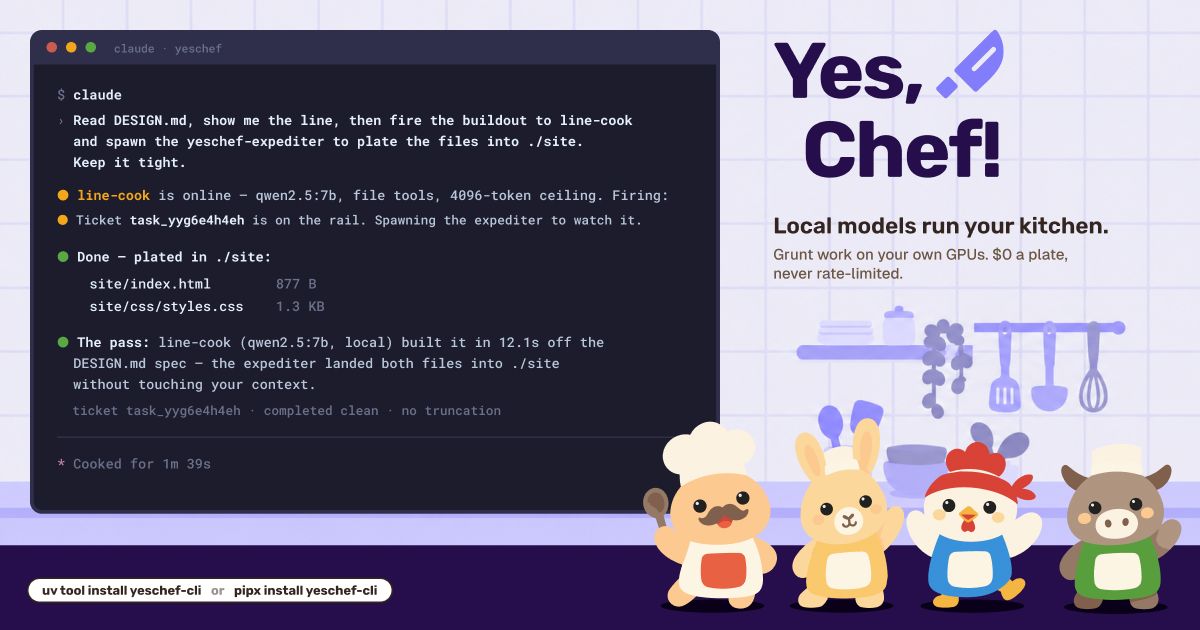
Announcement
Yes, Chef: Delegate Tasks to Local Models with Claude and Codex
Allow Claude Code and Codex to hand off tasks to local subagents (cooks), and save on token costs.
Read more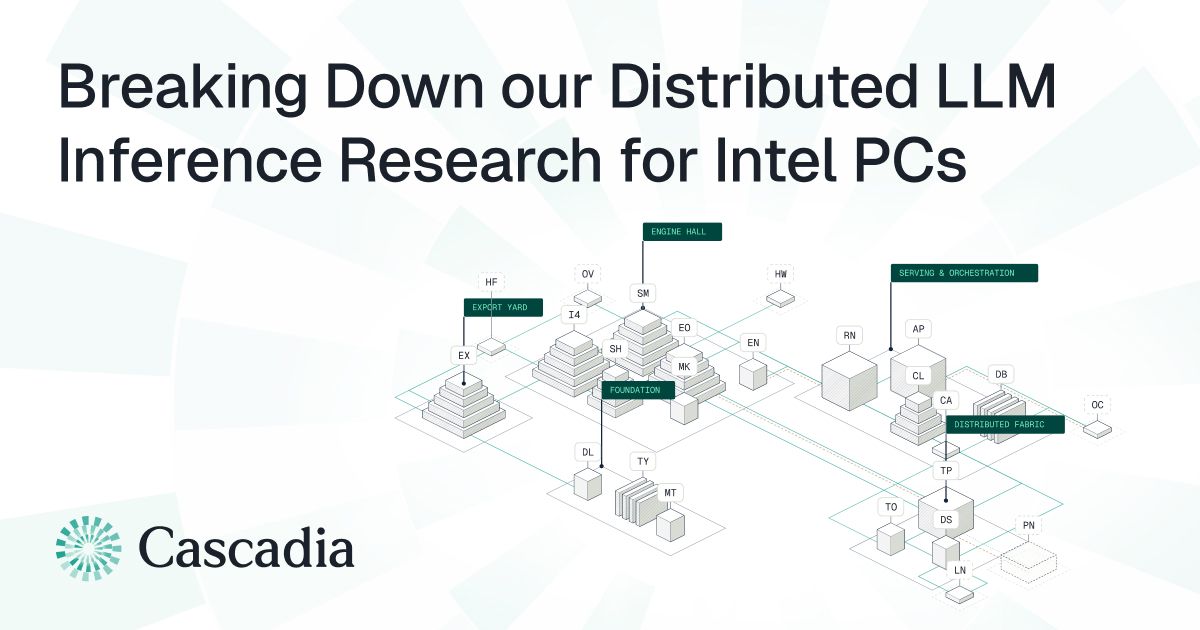
Research
Inside Our Distributed LLM Inference Research for Intel PCs
Exploring the optimization techniques for the sharded inference behind Cascadia.
Read more
