- Intel Core Ultra PCs
11
- Peak aggregate throughput
60.29tok/s
- Concurrent streams at peak
88
At a glance
- Partner
- Intel
- Industry
- Technology
- Use case
- Frontier-scale inference on client hardware
- Model
- Inkling (975B), Thinking Machines
- Hardware
- 11× Core Ultra X7 358H, Arc B390 iGPU, 64GB RAM each
- Network
- Gigabit Ethernet
Key takeaways
- 01
Frontier-scale open-weight models run on ordinary PCs.
A small fleet of regular machines held and served all 975B of Inkling’s parameters.
- 02
Throughput grows with users.
Aggregate throughput climbed with concurrency and peaked at 60.29 tok/s with 88 streams at once.
- 03
No data-center networking infrastructure needed.
The machines connected over plain Gigabit Ethernet, with no InfiniBand or other high-speed interconnect.
The challenge
No single PC can hold a model of this size.
Open-weight models keep getting bigger. Inkling by Thinking Machines has almost 1T parameters, and models of that size are normally trained and served on data-center hardware.
Pooling the memory and compute of several machines makes it possible in principle, but getting a model this large to run efficiently across a fleet of ordinary PCs is the hard part. Intel wanted to know whether its new Core Ultra machines were capable of doing it.
Intel is focused on engineering the next wave of computing, where AI workloads are distributed, efficient, and closer to where data is generated. We’re excited to be working with Cascadia to enable consumer/enterprise AI PCs to run models previously impossible and help bring efficient distributed AI to more environments.

The approach
Split the model into six-layer shards, one per machine.
We ran Inkling on eleven Intel Core Ultra X7 PCs, each with an Arc B390 iGPU and 64GB of RAM (704GB in total), connected over Gigabit Ethernet.
- Machines
- 11
- CPU
- Intel Core Ultra X7 358H
- GPU
- Intel Arc B390 integrated graphics
- Memory
- 64GB per machine, 704GB in total
- Network
- Gigabit Ethernet
- Runtime
- Cascadia (Rust + OpenVINO)
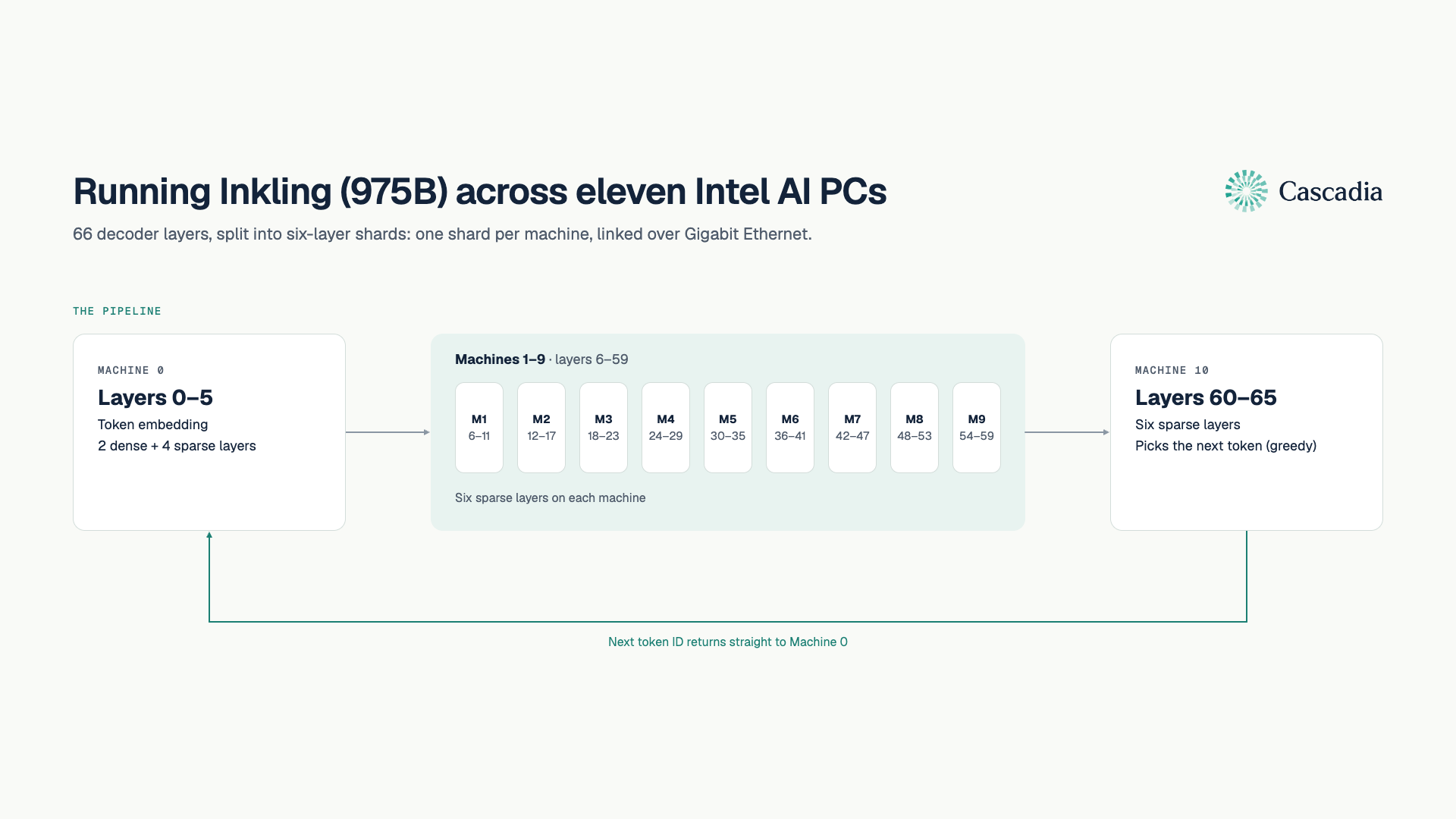
Inkling is a sparse Mixture-of-Experts model with 41B active parameters per token across 66 decoder layers. Cascadia split those layers into six-layer shards, one per machine: Machine 0 holds the embeddings and the first six layers, Machines 1–9 each hold six sparse layers, and Machine 10 runs the last six and picks the next token.
A custom MoE engine for Core Ultra
On each machine, Cascadia splits the work between the CPU and the iGPU. The CPU handles attention, routing tokens to experts, and request tracking; the iGPU runs the expert calculations and compressed projections using OpenVINO’s fused MoE operations, while Cascadia keeps control of routing.
Expert weights are INT4, attention projections and the output head are INT8, and the residual stream stays at FP32.
8.1 → 4.5ms
Time per dense layer, down from about 8.1ms, after we re-expressed Inkling’s two dense layers as always-on expert slices on the same fused path.
The results
Throughput climbed with every user, peaking at 60.29 tok/s.
Each request generated 128 tokens with greedy decoding at Cascadia’s default 1,024-token context. Aggregate throughput climbed with concurrency and peaked at 60.29 tok/s with 88 concurrent streams.
Aggregate decode throughput by concurrent streams
tok/s · 128 tokens per request · greedy decoding
- 1 stream7.96
- 8 streams18.60
- 32 streams38.31
- 64 streams53.60
- 88 streams60.29Peak
- 176 streams57.72
Single-stream speed was modest at roughly 5–10 tok/s, which makes this setup best suited to multi-user serving and background work. The point was never single-user speed: it was proving that an organization’s existing fleet of PCs can serve a model this large at all.
Resources
Read the full report.
The paper, the engineering write-up and the source code are all linked below.
- Read on arXiv
Paper
The full methodology and every run
- Read the write-up
Engineering blog
Running Inkling (975B) across eleven Intel PCs
- View on GitHub
Source
Inkling support in Cascadia
Research with Intel
The methods behind the numbers, co-authored with Intel engineers.
- Read the paper
Paper · October 2026
Cascadia: Resident 975B MoE Inference on Eleven AI PCs
Tate Berenbaum, Matias Parij (Community Labs) · Muthaiah Venkatachalam (Intel)
- Read the paper
Paper · September 2026
Cascadia: A Control-Plane-Free Alternative to Hyperconverged AI Infrastructure
Matias Parij, Pawan Paudel, Tate Berenbaum (Community Labs) · Muthaiah Venkatachalam (Intel)
- Read the paper
Paper · August 2026
Pre-Compiled Pipeline Shards for Distributed LLM Inference on Intel AI PC Fleets
Tate Berenbaum (Community Labs) · Muthaiah Venkatachalam (Intel)